
THE INTELLIGENT POWER LEADERSHIP PROGRAMME
From power-poor to decision-rich.
15 Sessions · 25 Minutes Per Day · Three Weeks · Free · For leaders in Nigeria’s power and energy sector

Hello — I am Coach Ritchie. I am the AI assistant for this programme. Ritchie Wingo built me, and your work is marked against the rubric he published; anything that falls below the mark to continue, he reviews himself, because that is the point at which a person needs help rather than a score. I am here for the moments in between, when the steering committee meets on Monday and you want to argue a point through with someone first.
Fifteen sessions, twenty-five minutes a day, three weeks. Electricity is an operating business with consequences well beyond the company supplying it. Artificial intelligence enters it through decisions, and its value depends on what people can do with the output. Where a line needs reinforcement, a transformer needs replacement or a plant lacks fuel, a model cannot supply the missing asset or resource. This programme teaches you to begin with one bounded decision, establish the baseline, protect customers and assets, and investigate at a cost the company can control.
Every assignment is about your company and the one unresolved decision that currently costs it time, money or service, and every assignment comes back with a written letter: what holds up and why, and where something is thin, exactly where to look. By Session 15 you will hold a signed 90-Day AI Readiness Plan for that decision, with the board readiness scorecard scored on evidence.
Ask me anything as you work and I will help you think it through, but I will not write your plan for you, I do not give investment, legal or engineering advice, and I switch myself off while you sit a quiz or an exam.
There is nothing to buy and no licence key to redeem. You sign in with your Google account so that your work can be marked and returned to you, your progress page follows you between devices, and your certificate can be issued in your own name.
With your Google account. Name, email, the company you work for and your role — that is the whole enrolment.
The decision-rich power sector and the six frameworks. Name your company and the one decision you will carry.
Twenty-five minutes, then one written assignment. It is marked against a published rubric and comes back as a letter.
You assemble and sign your ninety-day plan, sit the final, and your certificate is issued.
Already started? Open my progress page → · Just looking? Read Week 1 →
This programme assumes you are not a data scientist and do not intend to become one. It ends with you able to ask of any AI proposal what decision it changes, who owns the action, what evidence shows it worked — and to choose a simpler method, or stop, when that is the better answer.
Read sector figures with care, define a decision that can change, and locate the real constraint — decisions, not megawatts.
Treat a prediction as conditional evidence, put generated language under review, and evaluate against the operating alternative.
Across generation, distribution, transmission, supply, mini-grids and projects, follow the business that receives the recommendation.
Usable evidence for one decision, authority beside responsibility, and people trained for their actual duties.
Separate demonstration from evaluation, cost the complete service, negotiate evidence and exit, and decide to buy, build or wait.
A charter before a demonstration, a baseline and comparison, and an observation period that can reveal the result.
A finance-signed result without claiming causation, and governance of the consequence, customers and the control boundary.
A working home for the recommendation, a decision record, ninety days stage by stage, and a board readiness scorecard.
| It is written for | It is not written for |
|---|---|
| Executives of Nigerian power and energy businesses — generation, transmission and system operation, distribution, electricity supply and mini-grids | Engineers looking for model-building or coding work — that is a different course |
| Managing directors and executive and non-executive directors who sign the cheque and remain accountable for the result | Anyone looking for investment, legal or engineering advice on a specific asset |
| Heads of operations, commercial, metering, collections, finance, risk, technology and regulatory affairs whose decisions the plan depends on | Anyone wanting a certificate without writing about a real company |
| Leaders of organisations that develop and finance energy projects | Anyone expecting twenty minutes of video and a pass |
This programme does not end in a folder of notes. In Session 1 you name your company and the one unresolved decision that currently costs it time, money or service, and every session after that writes one section of a single document — your 90-Day AI Readiness Plan — around it. By Session 15 you assemble and sign it. Written properly, it is the paper you table at your next executive committee or board meeting.
| Week | Sections you write |
|---|---|
| Week 1 Define the Decision and Choose the Opportunity | 1. Section 1 — Our company, the one decision we will carry, and where its loop breaks. 2. Section 2 — Our reports, the decision defined so it can change, and the review that leads to work. 3. Section 3 — The constraint located, the whole transaction traced and the right level of automation. 4. Section 4 — The output we would use, its test against the current method, and the limitation in board language. 5. Section 5 — The business that receives the recommendation, the conversion test and the use we can execute. |
| Week 2 Foundations, Procurement and the First Intervention | 6. Section 6 — The evidence for our decision: identity, time, units, target meaning and the protected boundary. 7. Section 7 — Authority beside responsibility, the work designed with its people and the inheriting manager. 8. Section 8 — What we would buy, the complete cost and the evidence, exit and payment terms. 9. Section 9 — The intervention charter: question, baseline, comparison, capacity and observation period. 10. Section 10 — Buy, build or wait, decided on the responsibility we can sustain. |
| Week 3 Value, Governance and Execution | 11. Section 11 — The business result, the mechanism, the input register and a finance-signed treatment of value. 12. Section 12 — Governing the consequence: guidance, customers, control boundary, release and remedy. 13. Section 13 — The working home, decision record, operating rhythm and regulatory evidence register. 14. Section 14 — The ninety days drafted stage by stage with the evidence and decision at each review. 15. The signed 90-Day AI Readiness Plan. |
This programme is free, and nothing is upsold to you inside it. When you finish, you receive an ERW CommandPower certificate of completion in your own name — issued on a pass, not on attendance.
| To receive it | What that means |
|---|---|
| Every assignment passed | Sessions 1 to 14, each marked at 70 or above against its published rubric. Work below the mark comes back with what to fix; resubmit and the new mark replaces the old one. |
| The capstone passed | Your signed 90-Day AI Readiness Plan, Session 15, marked at 70 or above. |
| The Final Exam passed | Fifteen questions, three of them rebuilt from your own earlier mistakes, at 70 or above. |
The certificate is emailed to the Google address you signed in with. It certifies completion of an ERW leadership programme; it is not a professional licence, an engineering qualification or a university award.
Only people who have finished the programme can write one — the Session 15 capstone passed and the marked Final passed, both recorded by the server rather than by anyone’s say-so. They are shown exactly as written, never solicited and never edited.
One session a day, twenty-five minutes. Each one teaches part of the doctrine and makes you use it on your own company.
Every session ends in a written assignment — a diagnosis, a value case, a pilot design, a plan section. Four hundred to nine hundred words.
Against the rubric printed under the assignment. A written letter comes back, usually within minutes.
Session 15 assembles fourteen sections into one document, then the final exam — three of whose questions are rebuilt from your own mistakes.
No mystery, and no waiting days for a mark. Here is the whole loop.
One document per session — Word or Google Docs — with the first line reading Session: N. Your own company, your own numbers.
Against that session’s published rubric, criterion by criterion. The same rubric every time, for everybody.
Not a score — a letter naming what holds up, what is asserted without evidence, and exactly where to look to fix it.
Your mark joins your progress page and the corrected section goes into your plan, so Session 15 is assembly rather than writing.
An illustration of the letter format, using Session 3’s real rubric.
| Criterion | Awarded |
|---|---|
| Names the binding constraint among the five causes and shows how causes interact | 24 / 25 |
| Traces a whole transaction and an exception with the stages where evidence and responsibility change | 19 / 25 |
| Separates decision latency from execution latency and addresses the tail, not only the average | 20 / 20 |
| Justifies the level of automation against a simpler method and writes a constraint statement with competing interventions | 16 / 30 |
Three weeks. Five sessions a week, twenty-five minutes each, at whatever pace your diary allows. Every session ends in one written assignment about your own company, and every assignment becomes a section of your ninety-day plan.
Seven papers, marked the moment you submit, every question returned with the reasoning behind it. Three pop quizzes of five questions, three practice exams of fifteen, and a fifteen-question final. You are never left to guess when to sit one: the session that opens a paper says so, prints the paper beside its assignment, and flags itself on the session tab — and your progress page always names the paper due now. Closed book, no notes, and Coach Ritchie switches himself off while you sit one. Pass mark 70 — and you may resit the practice papers as often as you like.
5 questions · after Session 3
15 questions · after Session 5, closing Week 1
5 questions · after Session 8
15 questions · after Session 10, closing Week 2
5 questions · after Session 13
15 questions · after Session 14, before the final
15 questions · in Session 15
Fourteen sections written one per session, assembled and signed in Session 15: the one decision you carry and where its loop breaks, the constraint behind it and the use your company can execute, the data, people and procurement it depends on, the charter and the buy, build or wait choice, how value is measured and signed by finance, how the consequence is governed and the work is run, the ninety days stage by stage, and the board readiness scorecard scored on evidence.
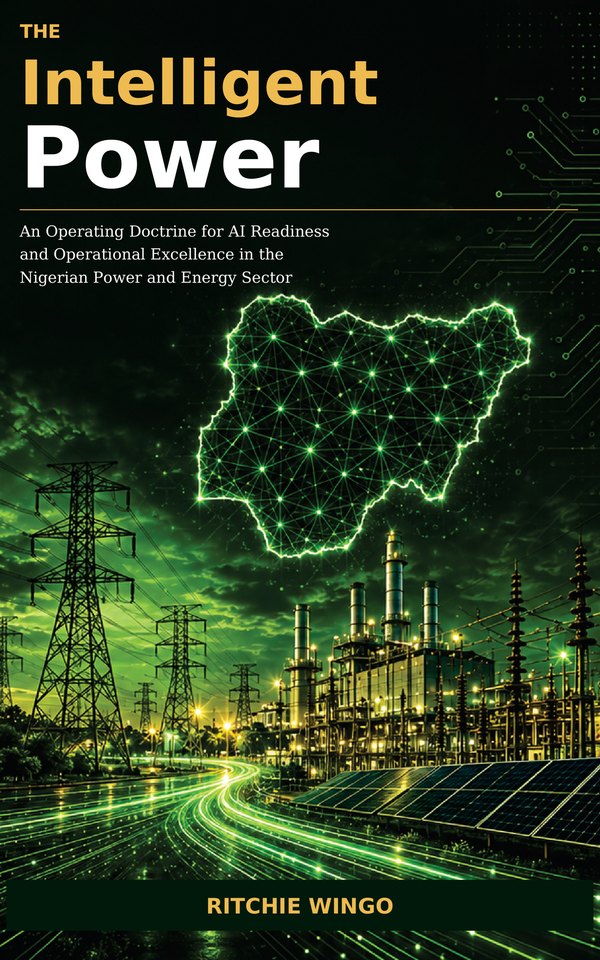
The Intelligent Power — An Operating Doctrine for AI Readiness and Operational Excellence in the Nigerian Power and Energy Sector. A compact executive book: a reader’s toolkit of six frameworks and thirteen chapters covering generation, transmission and system operation, distribution, electricity supply, mini-grids and the organisations that develop and finance energy projects. Chapters 1 to 4 define the decision and choose an opportunity; Chapters 5 to 7 examine company foundations and procurement; Chapters 8 to 13 take the reader through a first intervention, value measurement, governance and everyday execution.
These 15 sessions teach the doctrine and make you use it. The book carries what twenty-five minutes cannot: every chapter in full with its figures and sources, the regulatory orientation, the board AI readiness scorecard and a source index with full references.
Nothing in this programme depends on buying it. Every session, paper and certificate is free whether you own the book or not.
The whole programme on one printable page — the six frameworks, the decision record, the ninety days stage by stage and the board AI readiness scorecard. Keep it beside you from Week 1.
The document every assignment is written in — opens in Word or Google Docs, with the first line already correct.
Read the first session before you sign in, and decide for yourself whether the rest is worth three weeks.
Your marks, your letters, your plan sections and your paper results, in one place.
| Question | Answer |
|---|---|
| Is it really free? | Yes. No card, no key, no paid tier. The certificate is free too. The book is available separately for anyone who wants the full chapters, figures and sources, and nothing in the programme depends on it. |
| How much time, honestly? | Twenty-five minutes of reading and thirty to sixty minutes of writing per session. Call it six to eight hours over three weeks, and rather more if you do the capstone properly. |
| Do I need a technical background? | No. The technical sessions teach you what to ask, not how to build. You need a real company, a real decision, and the willingness to look at both honestly. |
| Is this specific to power? | Yes. It is written for the Nigerian power and energy sector — generation, transmission and system operation, distribution, electricity supply, mini-grids, and the organisations that develop and finance energy projects. Every session sets a case on the plant and network — the asset, the condition, the field work — beside the same decision in the commercial chain: the account, the bill, the collection, the contract and the board. |
| Is this investment or legal advice? | No. It is an operating doctrine for leaders. Figures and regulator facts are taught only as the book states and sources them. |
| Can my leadership team do it together? | Yes, and it works better that way — but each person signs in and submits their own work, because the plan is only useful if it is argued over. |
| What if I miss a week? | Nothing happens. There are no cohort dates and no deadlines. Your progress waits for you. |
| Who marks it? | It is marked against R. Wingo’s published rubric, criterion by criterion, the same way every time. Anything that comes out below the mark to continue, he reviews himself before it reaches you. Coach Ritchie helps you think; he does not mark and he does not write your plan. |