
THE INTELLIGENT PETROCHEMICAL COMPANY LEADERSHIP PROGRAMME
The decision behind the chemical.
20 Sessions · 25 Minutes Per Day · Four Weeks · Free · For leaders in Nigeria’s petrochemical and specialty chemical sector

Hello — I am Coach Ritchie. I am the AI assistant for this programme. Ritchie Wingo built me, and your work is marked against the rubric he published; anything that falls below the mark to continue, he reviews himself, because that is the point at which a person needs help rather than a score. I am here for the moments in between, when the steering committee meets on Monday and you want to argue a point through with someone first.
Twenty sessions, twenty-five minutes a day, four weeks. A petrochemical company has to connect technical performance with commercial discipline. Feedstock, production, formulation, product quality and customer application each affect the result. Artificial intelligence becomes useful when it supports a decision within that pattern — and you still need to know which decision will change, who can authorise that change and how its effect will be measured.
Every assignment is about your company and one recurring decision with a meaningful consequence, and every assignment comes back with a written letter: what holds up and why, and where something is thin, exactly where to look. By Session 20 you will hold a signed 90-Day AI Leadership Plan for that decision, with its pilot charter and acceptance gates.
Ask me anything as you work and I will help you think it through, but I will not write your plan for you, I do not give investment, legal or engineering advice, and I switch myself off while you sit a quiz or an exam.
There is nothing to buy and no licence key to redeem. You sign in with your Google account so that your work can be marked and returned to you, your progress page follows you between devices, and your certificate can be issued in your own name.
With your Google account. Name, email, the company you work for and your role — that is the whole enrolment.
The decision behind the chemical and the six frameworks. Name your company, its business model and the one decision you will carry.
Twenty-five minutes, then one written assignment. It is marked against a published rubric and comes back as a letter.
You assemble and sign your ninety-day plan, sit the final, and your certificate is issued.
Already started? Open my progress page → · Just looking? Read Week 1 →
This programme assumes you are not a data scientist and do not intend to become one. It ends with you able to ask of any AI proposal what decision it changes, who owns the action, what evidence shows it worked — and to choose a simpler method, or stop, when that is the better answer.
Own the decision, give it an executable owner, and know which business model you actually run.
Use the correct denominator, test the alternative, and keep cash a separate question.
Define the material before comparing offers, find the binding constraint, and price the whole yield improvement.
Keep prediction apart from measurement, protect release, and agree the customer trial before recommending.
Start from failure consequence, make inventory physical, and keep safety and environmental evidence honest.
Build the cash calendar and find the funding trough; keep information access separate from control.
Make human review substantial, count value once, and stage funding around the uncertainty that remains.
A pilot charter, five acceptance gates, shadow mode, defined authority and a decision on the next stage.
| It is written for | It is not written for |
|---|---|
| Leaders of Nigerian petrochemical, industrial-chemical and specialty-chemical businesses — producers, formulators, specialist suppliers and suppliers with technical service | Engineers looking for model-building or coding work — that is a different course |
| Managing directors and directors who fund the programme and own its outcome | Anyone looking for investment, legal, regulatory or engineering advice on a specific plant or product |
| Heads of operations, production, quality and laboratory, technical service, supply chain, finance, HSE and technology whose decisions the plan depends on | Anyone wanting a certificate without writing about a real company |
| Leaders of distributors and traders who need to understand how a chemical supplier’s decisions are made | Anyone expecting twenty minutes of video and a pass |
This programme does not end in a folder of notes. In Session 1 you name your company, its business model and one recurring decision with a meaningful consequence, and every session after that writes one section of a single document — your 90-Day AI Leadership Plan — around it. By Session 20 you assemble and sign it. Written properly, it is the paper you table at your next executive committee or board meeting.
| Week | Sections you write |
|---|---|
| Week 1 Leadership, the Business Model and Feedstock | 1. Section 1 — Our company, its business model, the one decision we will carry and where its loop breaks. 2. Section 2 — The operating question, its executable owner and the review that resolves it. 3. Section 3 — Our business-model record, our place in the value chain and the method that fits. 4. Section 4 — The denominator, the alternative, the contribution bridge and the cash question. 5. Section 5 — The material defined, lot evidence preserved and the usable date modelled. |
| Week 2 Production, Quality and the Customer | 6. Section 6 — The binding constraint, hard constraints versus preferences and the problem formulated. 7. Section 7 — Physical accounting, the approved recipe, the whole improvement priced and what a pilot must earn. 8. Section 8 — Prediction kept apart from measurement, exceptions investigated and release protected. 9. Section 9 — The application defined, the trial agreed and the AI component judged on its own contribution. 10. Section 10 — The objective, units and basis, separated authority and the evidence for expansion. |
| Week 3 Reliability, Resources and Enterprise Execution | 11. Section 11 — Failure consequence, the failure label, the warning window and the response chain priced. 12. Section 12 — Critical dependencies, physical inventory status and degraded operation planned. 13. Section 13 — Specific hazard knowledge, visible change, the obligation register and the condition of protections. 14. Section 14 — The cash calendar, the funding trough and the downside tests. 15. Section 15 — Stable identities, the data contract, access kept from control and recovery tested. |
| Week 4 Authority, Governance and the First Ninety Days | 16. Section 16 — The role, substantial review, a demonstration that can fail and review capacity before permission. 17. Section 17 — The credible baseline, value counted once, governance of the actual system and staged funding. 18. Section 18 — The ninety days stage by stage, the gates between them and the rhythm after day 90. 19. Section 19 — The operating record that matters most for our decision, completed from real evidence. 20. The signed 90-Day AI Leadership Plan. |
This programme is free, and nothing is upsold to you inside it. When you finish, you receive an ERW CommandPetrochemical certificate of completion in your own name — issued on a pass, not on attendance.
| To receive it | What that means |
|---|---|
| Every assignment passed | Sessions 1 to 19, each marked at 70 or above against its published rubric. Work below the mark comes back with what to fix; resubmit and the new mark replaces the old one. |
| The capstone passed | Your signed 90-Day AI Leadership Plan, Session 20, marked at 70 or above. |
| The Final Exam passed | Fifteen questions, three of them rebuilt from your own earlier mistakes, at 70 or above. |
The certificate is emailed to the Google address you signed in with. It certifies completion of an ERW leadership programme; it is not a professional licence, an engineering qualification or a university award.
Only people who have finished the programme can write one — the Session 20 capstone passed and the marked Final passed, both recorded by the server rather than by anyone’s say-so. They are shown exactly as written, never solicited and never edited.
One session a day, twenty-five minutes. Each one teaches part of the doctrine and makes you use it on your own company.
Every session ends in a written assignment — a diagnosis, a value case, a pilot design, a plan section. Four hundred to nine hundred words.
Against the rubric printed under the assignment. A written letter comes back, usually within minutes.
Session 20 assembles nineteen sections into one document, then the final exam — three of whose questions are rebuilt from your own mistakes.
No mystery, and no waiting days for a mark. Here is the whole loop.
One document per session — Word or Google Docs — with the first line reading Session: N. Your own company, your own numbers.
Against that session’s published rubric, criterion by criterion. The same rubric every time, for everybody.
Not a score — a letter naming what holds up, what is asserted without evidence, and exactly where to look to fix it.
Your mark joins your progress page and the corrected section goes into your plan, so Session 20 is assembly rather than writing.
An illustration of the letter format, using Session 3’s real rubric.
| Criterion | Awarded |
|---|---|
| Completes every field of the business-model record, including decisions needing another party's approval | 24 / 30 |
| Locates the company on the operating map and names the correct yield or acceptance measure | 19 / 25 |
| Matches the method to the decision and keeps each component's evaluation separate | 20 / 25 |
| Rejects one unsuitable application with a reason drawn from the record | 16 / 20 |
Four weeks. Five sessions a week, twenty-five minutes each, at whatever pace your diary allows. Every session ends in one written assignment about your own company, and every assignment becomes a section of your ninety-day plan.
Nine papers, marked the moment you submit, every question returned with the reasoning behind it. Four pop quizzes of five questions, four practice exams of fifteen, and a fifteen-question final. You are never left to guess when to sit one: the session that opens a paper says so, prints the paper beside its assignment, and flags itself on the session tab — and your progress page always names the paper due now. Closed book, no notes, and Coach Ritchie switches himself off while you sit one. Pass mark 70 — and you may resit the practice papers as often as you like.
5 questions · after Session 3
15 questions · after Session 5, closing Week 1
5 questions · after Session 8
15 questions · after Session 10, closing Week 2
5 questions · after Session 13
15 questions · after Session 15, closing Week 3
5 questions · after Session 18
15 questions · after Session 19, before the final
15 questions · in Session 20
Nineteen sections written one per session, assembled and signed in Session 20: the one decision you carry, your business model and where its loop breaks, the denominator, the material and the binding constraint, yield, release and the customer application, reliability, utilities, safety and the cash calendar, data, people and authority, the investment case and governance, the ninety days stage by stage, and the pilot charter with its five acceptance gates.
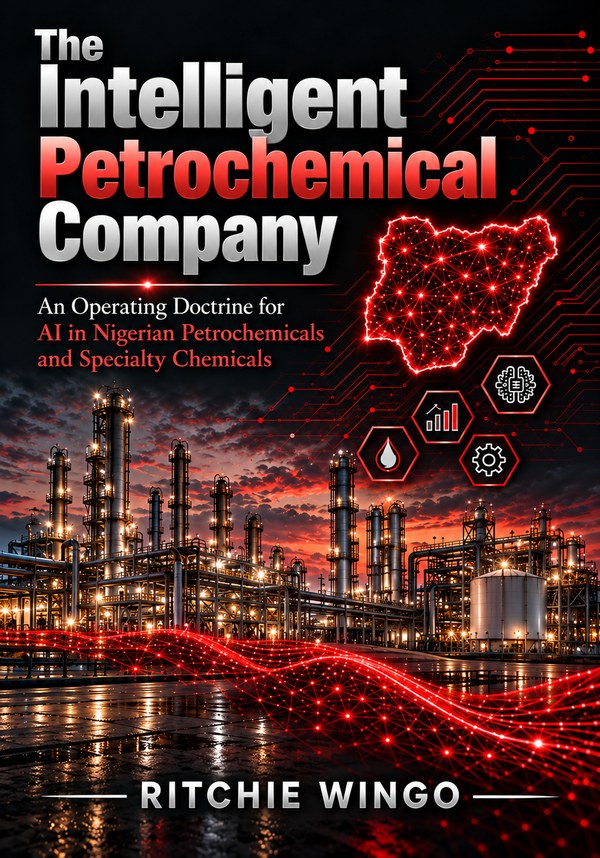
The Intelligent Petrochemical Company — An Operating Doctrine for AI in Nigerian Petrochemicals and Specialty Chemicals. A reader’s toolkit of six frameworks and seventeen chapters in six parts: leadership and the business model; feedstock and production; quality and customer application; reliability and resources; enterprise execution; and governance and scale. It connects technical performance with commercial discipline — from the material bought to the product released, the customer application and the cash collected.
These 20 sessions teach the doctrine and make you use it. The book carries what twenty-five minutes cannot: every chapter in full with its sources, the four extended worked cases, and nine practical appendices — from the lot traceability review and quality exception log to the pilot charter, benefit ledger and Nigerian procurement and commitment review.
Nothing in this programme depends on buying it. Every session, paper and certificate is free whether you own the book or not.
The whole programme on one printable page — the six frameworks, the decision record, the pilot charter and five acceptance gates, and the ninety days stage by stage. Keep it beside you from Week 1.
The document every assignment is written in — opens in Word or Google Docs, with the first line already correct.
Read the first session before you sign in, and decide for yourself whether the rest is worth four weeks.
Your marks, your letters, your plan sections and your paper results, in one place.
| Question | Answer |
|---|---|
| Is it really free? | Yes. No card, no key, no paid tier. The certificate is free too. The book is available separately for anyone who wants the full chapters, figures and sources, and nothing in the programme depends on it. |
| How much time, honestly? | Twenty-five minutes of reading and thirty to sixty minutes of writing per session. Call it ten to twelve hours over four weeks, and rather more if you do the capstone properly. |
| Do I need a technical background? | No. The technical sessions teach you what to ask, not how to build. You need a real company, a real decision, and the willingness to look at both honestly. |
| Is this specific to petrochemicals? | Yes. It is written for Nigerian petrochemical, industrial-chemical and specialty-chemical businesses — continuous producers, batch formulators, specialist suppliers and suppliers with technical service — without treating them as identical. Every session sets a case in the plant — the material, the lot, the laboratory, the equipment — beside the same decision in the margin: contribution, cash, the customer contract and the executive review. |
| Is this investment or legal advice? | No. It is an operating doctrine for leaders. Figures and regulator facts are taught only as the book states and sources them. |
| Can my leadership team do it together? | Yes, and it works better that way — but each person signs in and submits their own work, because the plan is only useful if it is argued over. |
| What if I miss a week? | Nothing happens. There are no cohort dates and no deadlines. Your progress waits for you. |
| Who marks it? | It is marked against R. Wingo’s published rubric, criterion by criterion, the same way every time. Anything that comes out below the mark to continue, he reviews himself before it reaches you. Coach Ritchie helps you think; he does not mark and he does not write your plan. |