
THE INTELLIGENT REGULATOR LEADERSHIP PROGRAMME
Put judgement where it belongs.
15 Sessions · 25 Minutes Per Day · Three Weeks · Free · For regulators and regulated companies in Nigeria’s petroleum industry

Hello — I am Coach Ritchie. I am the AI assistant for this programme. Ritchie Wingo built me, and your work is marked against the rubric he published; anything that falls below the mark to continue, he reviews himself, because that is the point at which a person needs help rather than a score. I am here for the moments in between, when the steering committee meets on Monday and you want to argue a point through with someone first.
Fifteen sessions, twenty-five minutes a day, three weeks. Nigeria’s petroleum industry asks much of its regulatory institutions: public safety, investment confidence, environmental protection, national revenue, fair market access and community interests meet in decisions that often arrive as fragmented files. AI can help organise evidence, reconcile inconsistent records, retrieve relevant provisions and prioritise matters for qualified review. It can also produce a convincing but incorrect legal answer, an unfair risk score, an accidental disclosure or a decision whose reasoning cannot be reconstructed. This programme is for both sides of that relationship — the regulator and the regulated company — and it teaches one discipline: make the evidence reliable, put judgement where it belongs and close the loop after action.
Every assignment is about your organisation and the one decision in the regulatory relationship that currently costs it time, quality or trust, and every assignment comes back with a written letter: what holds up and why, and where something is thin, exactly where to look. By Session 15 you will hold a signed 90-Day Regulatory AI Plan for that decision, with its pilot charter, decision rights and executive scorecard.
Ask me anything as you work and I will help you think it through, but I will not write your plan for you, I do not give legal, investment or engineering advice, nothing here is an official interpretation issued by a regulator, and I switch myself off while you sit a quiz or an exam.
There is nothing to buy and no licence key to redeem. You sign in with your Google account so that your work can be marked and returned to you, your progress page follows you between devices, and your certificate can be issued in your own name.
With your Google account. Name, email, the institution or company you work for and your role — that is the whole enrolment.
The intelligent regulator and the six frameworks. Name your organisation, your side of the relationship and the one decision you will carry.
Twenty-five minutes, then one written assignment. It is marked against a published rubric and comes back as a letter.
You assemble and sign your ninety-day plan, sit the final, and your certificate is issued.
Already started? Open my progress page → · Just looking? Read Week 1 →
This programme assumes you are not a data scientist and do not intend to become one. It ends with you able to ask of any AI proposal what decision it improves, who holds the lawful authority, who owns the next action and what evidence shows it worked — and to choose conventional software, a better checklist, or stop, when that is the better answer.
From regulatory data to public value: one decision in one sentence, an observed baseline, and the case, professional and service owners kept apart.
A controlled legal source register, law kept apart from implementation, and an obligation-to-evidence chain from provision to proof.
Provenance, identities and a record that can reconstruct a decision, inside an architecture that respects access and survives an outage.
Completeness kept apart from adequacy, queries that can be answered, and conditions specific enough to monitor.
Transparent prioritisation, verified closure, measurement reconciliation without accusation, and safety evidence that never delays escalation.
Funding, spending, delivery and service kept distinct, consultation made inspectable, and recourse people can understand.
Meaningful human review, fairness tests, an acceptance case, protected investigations and agents that cannot make an unauthorised determination.
A pilot charter, decision rights, a better regulatory partnership, capability you keep, and an executive scorecard that changes action.
| It is written for | It is not written for |
|---|---|
| Leaders in Nigerian petroleum regulatory institutions — commissioners, directors and the heads of licensing, inspection, measurement, host-community oversight, consumer affairs, legal and data | Engineers looking for model-building or coding work — that is a different course |
| Managing directors, boards and executive and non-executive directors of regulated companies, accountable for what the company submits and fulfils | Anyone looking for legal advice or an official interpretation of a specific obligation |
| Heads of compliance and regulatory affairs, legal, engineering, operations, finance, HSEQ, projects and community relations whose evidence the relationship depends on | Anyone wanting a certificate without writing about a real organisation |
| Case owners, inspectors and data specialists on either side who will run the service day to day | Anyone expecting twenty minutes of video and a pass |
This programme does not end in a folder of notes. In Session 1 you name your organisation, the side of the regulatory relationship it sits on, and the one decision in that relationship that currently costs it time, quality or trust, and every session after that writes one section of a single document — your 90-Day Regulatory AI Plan — around it. By Session 15 you assemble and sign it. Written properly, it is the paper you table at your next executive review or board meeting.
| Week | Sections you write |
|---|---|
| Week 1 The Inflection and the Foundations You Cannot Skip | 1. Section 1 — Our organisation, our side of the regulatory relationship, the one decision we will carry and where its loop breaks. 2. Section 2 — The public-value chain, the observed baseline, three statuses kept apart and the three owners. 3. Section 3 — The obligation-to-evidence chain and one Appendix B register entry, with law kept apart from implementation. 4. Section 4 — The evidence system: identities, provenance, the data contract and a decision we can reconstruct. 5. Section 5 — The architecture of trust: layers, the plant boundary, data protection, exchange events and the fallback. |
| Week 2 Intelligence in Regulatory Practice | 6. Section 6 — The decision route, completeness kept apart from adequacy, an answerable query and conditions that can be monitored. 7. Section 7 — Supervision and closure: the prioritisation method, the evidence boundary and verified closure. 8. Section 8 — The reconciliation: boundary, comparable basis, competing explanations and a benefit counted once. 9. Section 9 — Safety and environmental evidence: leading signals, escalation, provisional status, measurement basis and long-term obligations. 10. Section 10 — Accountable delivery: funding, spending, delivery and service kept distinct, and consultation made inspectable. |
| Week 3 Trust, Collaboration and the Leadership Game Plan | 11. Section 11 — Recourse: constraint, complaint, anomaly and breach kept apart, and a response people can understand. 12. Section 12 — Governance and fairness: the inventory, meaningful review, fairness tests, the acceptance case and the route to correction. 13. Section 13 — Investigation, security and controlled autonomy: the action boundary and the five acceptance gates. 14. Section 14 — The partnership and the capability: the submission and query discipline, waiting by cause, and the capability we keep. 15. The signed 90-Day Regulatory AI Plan. |
This programme is free, and nothing is upsold to you inside it. When you finish, you receive an ERW CommandRegulator certificate of completion in your own name — issued on a pass, not on attendance.
| To receive it | What that means |
|---|---|
| Every assignment passed | Sessions 1 to 14, each marked at 70 or above against its published rubric. Work below the mark comes back with what to fix; resubmit and the new mark replaces the old one. |
| The capstone passed | Your signed 90-Day Regulatory AI Plan, Session 15, marked at 70 or above. |
| The Final Exam passed | Fifteen questions, three of them rebuilt from your own earlier mistakes, at 70 or above. |
The certificate is emailed to the Google address you signed in with. It certifies completion of an ERW leadership programme; it is not a professional licence, an engineering qualification or a university award.
Only people who have finished the programme can write one — the Session 15 capstone passed and the marked Final passed, both recorded by the server rather than by anyone’s say-so. They are shown exactly as written, never solicited and never edited.
One session a day, twenty-five minutes. Each one teaches part of the doctrine and makes you use it on your own organisation.
Every session ends in a written assignment — a diagnosis, a value case, a pilot design, a plan section. Four hundred to nine hundred words.
Against the rubric printed under the assignment. A written letter comes back, usually within minutes.
Session 15 assembles fourteen sections into one document, then the final exam — three of whose questions are rebuilt from your own mistakes.
No mystery, and no waiting days for a mark. Here is the whole loop.
One document per session — Word or Google Docs — with the first line reading Session: N. Your own organisation, your own numbers.
Against that session’s published rubric, criterion by criterion. The same rubric every time, for everybody.
Not a score — a letter naming what holds up, what is asserted without evidence, and exactly where to look to fix it.
Your mark joins your progress page and the corrected section goes into your plan, so Session 15 is assembly rather than writing.
An illustration of the letter format, using Session 3’s real rubric.
| Criterion | Awarded |
|---|---|
| Builds the full chain without legal content beyond validated sources | 24 / 25 |
| Completes all thirteen fields with a valid status, law kept apart from implementation | 19 / 30 |
| Names the decision family and leaves the applicability question with a qualified reviewer | 20 / 15 |
| Shows how a source change propagates, with a named release owner | 16 / 20 |
Three weeks. Five sessions a week, twenty-five minutes each, at whatever pace your diary allows. Every session ends in one written assignment about your own organisation, regulator or company, and every assignment becomes a section of your ninety-day plan.
Seven papers, marked the moment you submit, every question returned with the reasoning behind it. Three pop quizzes of five questions, three practice exams of fifteen, and a fifteen-question final. You are never left to guess when to sit one: the session that opens a paper says so, prints the paper beside its assignment, and flags itself on the session tab — and your progress page always names the paper due now. Closed book, no notes, and Coach Ritchie switches himself off while you sit one. Pass mark 70 — and you may resit the practice papers as often as you like.
5 questions · after Session 3
15 questions · after Session 5, closing Week 1
5 questions · after Session 8
15 questions · after Session 10, closing Week 2
5 questions · after Session 13
15 questions · after Session 14, before the final
15 questions · in Session 15
Fourteen sections written one per session, assembled and signed in Session 15: the one decision you carry and where its loop breaks, its public value and owners, the obligation-to-evidence chain, the evidence system and the architecture of trust, the decision route, supervision and verified closure, the reconciliation, safety and environmental evidence, accountable delivery and recourse, governance and fairness, the action boundary, and the partnership and capability you keep — then the pilot charter, the decision rights, the ninety days stage by stage and the executive scorecard.
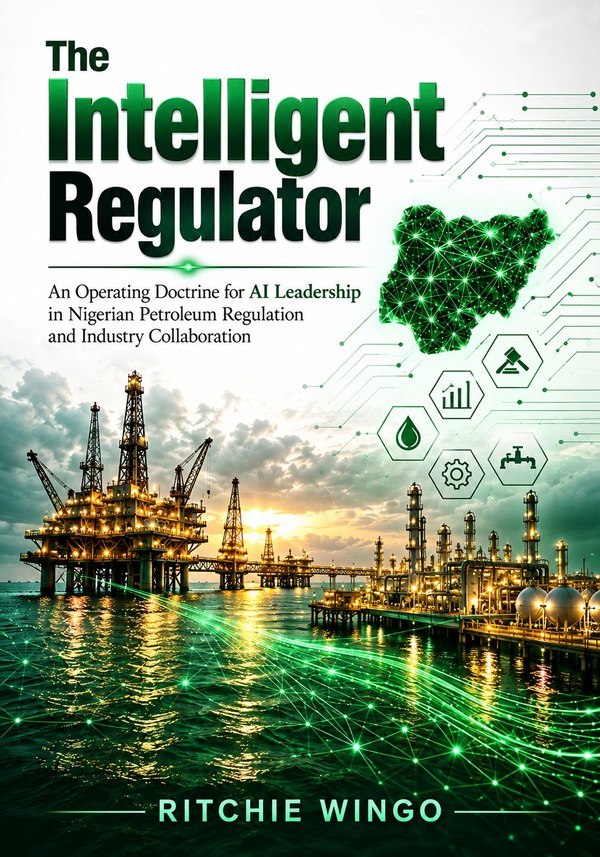
The Intelligent Regulator — An Operating Doctrine for AI Leadership in Nigerian Petroleum Regulation and Industry Collaboration. A compact executive book for both sides of the regulatory relationship: a reader’s toolkit of six frameworks, seventeen chapters and six working templates, written for institutional leaders, commissioners, directors, inspectors, legal and commercial teams, data specialists, compliance executives and company boards. Part One defines the leadership mandate; Part Two establishes the legal, data and technical foundations, with the Petroleum Industry Act 2021 as the operating backbone; Part Three applies intelligence to licensing, inspection, measurement, safety and environment, host communities and gas and downstream markets; Part Four addresses governance, enforcement, cybersecurity and controlled autonomy; Part Five deals with industry collaboration and Nigerian capability; Part Six turns the doctrine into an executable programme.
These 15 sessions teach the doctrine and make you use it. The book carries what twenty-five minutes cannot: every chapter in full with its sources, the six working templates — pilot charter, obligation and evidence register, decision rights and decision record, executive scorecard and benefits ledger, company submission and query templates, procurement and acceptance gates — a glossary and its numbered sources.
Nothing in this programme depends on buying it. Every session, paper and certificate is free whether you own the book or not.
The whole programme on one printable page — the six frameworks, the decision record and decision rights, the ninety days stage by stage and the executive scorecard. Keep it beside you from Week 1.
The document every assignment is written in — opens in Word or Google Docs, with the first line already correct.
Read the first session before you sign in, and decide for yourself whether the rest is worth three weeks.
Your marks, your letters, your plan sections and your paper results, in one place.
| Question | Answer |
|---|---|
| Is it really free? | Yes. No card, no key, no paid tier. The certificate is free too. The book is available separately for anyone who wants the full chapters, templates and sources, and nothing in the programme depends on it. |
| How much time, honestly? | Twenty-five minutes of reading and thirty to sixty minutes of writing per session. Call it six to eight hours over three weeks, and rather more if you do the capstone properly. |
| Do I need a technical background? | No. The technical sessions teach you what to ask, not how to build. You need a real organisation, a real decision, and the willingness to look at both honestly. |
| Is this specific to petroleum regulation? | Yes. It is written for both sides of Nigeria’s petroleum regulatory relationship — the regulatory institutions and the companies that deal with them, across upstream, midstream and downstream activity. Every session sets a case inside the regulator — the case record, the review, the inspection and the authorised decision — beside the same matter at the company: the obligation map, the submission pack, the query response and the evidence that a condition has been met. |
| I work for a company, not a regulator. Is it for me? | Yes. Wherever a chapter is written from the regulator’s side, you apply it to how your company prepares evidence for the regulator and works with it; where a chapter is written to companies, regulators apply it the other way round. |
| Is this legal advice? | No. It is an operating doctrine for leaders, and the book is not an official interpretation issued by a regulator. Statutes and regulator facts are taught only as the book states and sources them. |
| Can my leadership team do it together? | Yes, and it works better that way — but each person signs in and submits their own work, because the plan is only useful if it is argued over. |
| What if I miss a week? | Nothing happens. There are no cohort dates and no deadlines. Your progress waits for you. |
| Who marks it? | It is marked against R. Wingo’s published rubric, criterion by criterion, the same way every time. Anything that comes out below the mark to continue, he reviews himself before it reaches you. Coach Ritchie helps you think; he does not mark and he does not write your plan. |